
Lack of Attention to Core Values Will Cost General Motors Billions
(Toronto, Canada – June 12, 2014) — General Motors’ ignition switch problem has resulted in anywhere between 13 and 300 deaths – depending on which source proves to be accurate – and a recall of more than 2.6 million vehicles. It took more than 11 years for the organization to take the necessary action to fix the problem, according to a report issued by Anton Valukas, the former US Attorney charged with investigating the issue.
The Valukas Report identifies aspects of the corporate culture that prevented the issue from escalating to higher levels of management, including, an unwillingness to raise problems for fear that it may delay the launch of a vehicle, a fear of reprisals against employees that raise safety issues, a devotion to cost control that “permeates the fabric of the whole culture”, and the lack of accountability – referred to as the ‘GM salute’.
“An organization’s core values should be the foundation of its culture,” says Christie Christelis, CEO of Consilient Inc., a company that monitors how organizations live up to their stated values.
“In the case of GM, it is clear that the values embedded in the organization are not the same as their stated core values,” he says. “At the very least, they violated their stated values of ‘safety’, ‘accountability’, ‘quality’, and ‘customer focus’. One could also argue that they violated a few more along the way.”
Detroit Free Press credits Kathryn Harrigan, professor of business leadership at Columbia University, with saying that the old GM structure demonstrated to employees that safety was not a top priority to management and that this culture migrated into the rebooted GM after it obtained bankruptcy protection in 2009.
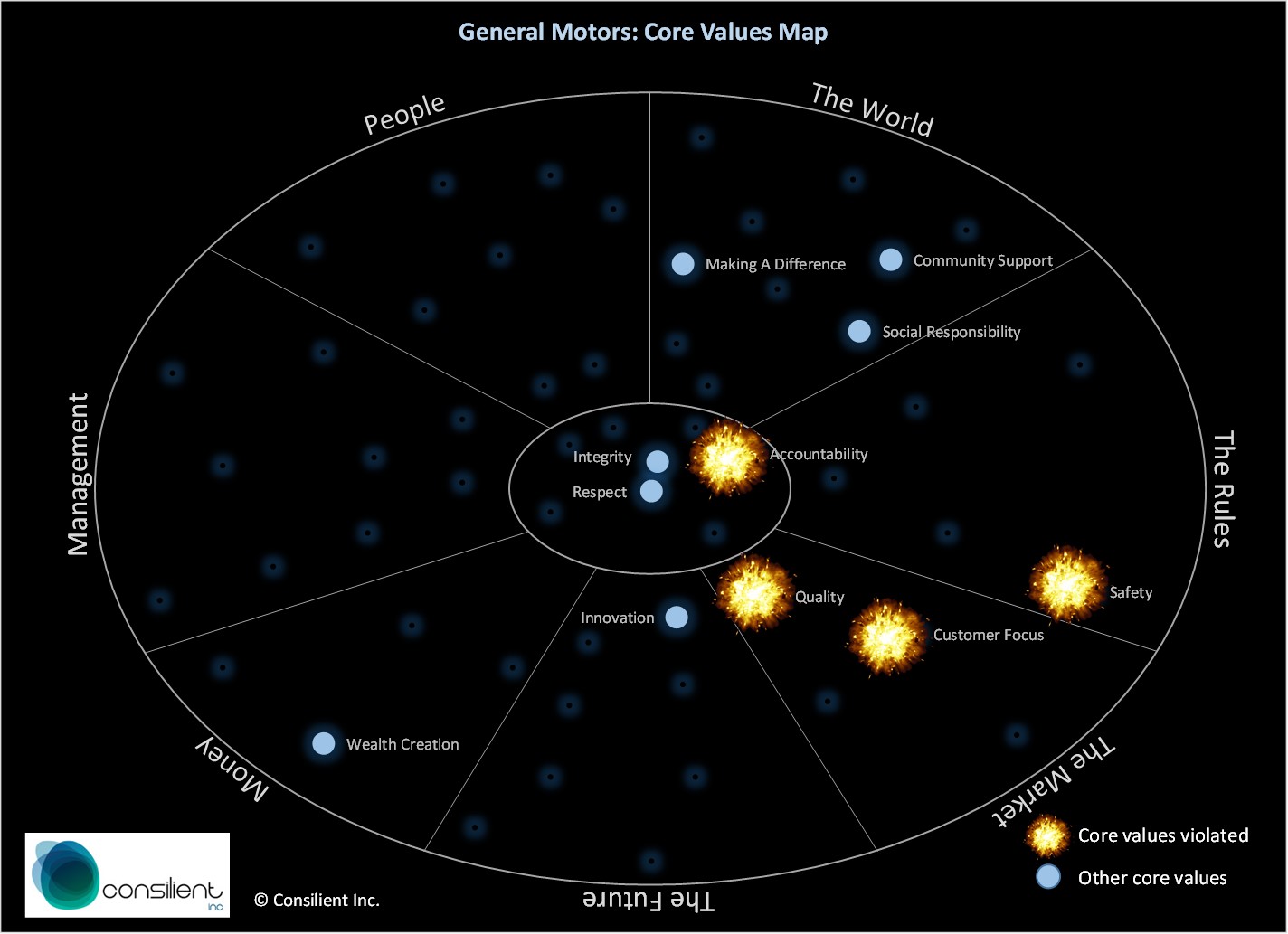
General Motors’ Core Values mapped onto the
Consilient Universal Organizational Values Framework.
Click to enlarge image
“All too often we see companies that proudly display their core values, but make no effort at embedding them into the organizations. It is often a checklist item that a management consultant is tasked to develop based on an off-site meeting of senior executives – and then it’s back to business as usual,” Christelis says. “These tend to be organizations that do not understand the importance of values, and how they can work for an organization. In some cases, it is just an organization that has lost its way. But the very essence of a core value is that it is prioritized over short-term profits.”
The cost of the GM ignition switch saga is likely to exceed $3 billion, according to the analysis conducted by Consilient Inc., and includes: the actual costs of the recall itself; additional fines by regulatory authorities; class action lawsuits; and wrongful death suits.
“We can also expect increased regulatory scrutiny of the company – and the industry as a whole – and reputational damage to GM could have a far-reaching long-term impact on market share and profitability,” Christelis says.
The Valukas Report, while scathing and calling out incompetence and neglect, concludes that the top three senior executives in the organization were not aware of the problem until very recently, exonerating them from any guilt. Some have viewed this conclusion with skepticism, maintaining that the investigation was funded by GM and there has been a long-standing relationship between Valukas and the firm.
US Senator Richard Blumenthal is on record as saying that the report “amounts to circling the wagons to marshal a legal defense,” and has labelled it as whitewashing.
Christelis maintains that the reputational damage to the firm will, at least in part, be determined by their actions going forward. Newly appointed GM CEO, Mary Barra, has already announced some sweeping changes in the safety management regime at GM, ushered 15 people out of the door, and pledged to bring the company back on track. But there is the issue of whether the company will shield itself behind its 2009 bankruptcy protection and distance itself from pre-July 2009 claims, or whether it will waive its immunity.
“If GM chooses to ignore earlier claims, the reputational damage could be severe, even though it may have a sound legal footing for doing so, because customers will no longer trust GM to do the right thing,” Christelis says. “This will demonstrate another set of values violations, namely, ‘integrity’ and ‘respect’ in favor of ‘wealth creation’.”
He points out that, while the costs of embedding its core values into an organization with 220,000 employees will be large, there would be huge benefits, namely, a reduced risk of adverse events such as this one, improved organizational functioning, increased employee pride (coupled with improved employee engagement and lower turnover) and increased customer commitment.
“Over the long-term, it will pay for itself many times over, and may even act as a bulwark against intense competition,” he says.
About Consilient Inc.
Consilient Inc. harnesses the power of converging knowledge from diverse data, information and knowledge sources to develop solutions to complex business problems. The Consilient Universal Organizational Values Framework allows companies to measure the extent to which their organizations are effective in embedding their core values into their organizations. The company works in collaboration with a network of specialist partners to effect business transformation. For more information please see: www.consilientinc.com
Media Contact Information:
For interviews please contact:
Christie Christelis, CEO,
Consilient Inc.
Tel: +1 905 617 3049
email: christie dot christelis at consilientinc dot com